
Advertising & Outdoor
Hoarding Design in Salem, Bus Wraps and Theatre Ads: What Works on the Road and on Screen
Practical advice on hoarding design in Salem, bus and van wraps and cinema spots, from the first idea to the day the work goes live.
By The Idea Shop team, Salem19 November 202611 min read

On this page
- One idea, four surfaces: planning creative for Salem's roads and screens
- Hoarding design in Salem: one message that reads at road speed
- Tamil, English or both: choosing words for Salem audiences
- Bus wraps: designing around windows, doors and wheel arches
- Van and vehicle branding: turning a vehicle into a moving shopfront
- Theatre commercials: what fits in 10 and 15 seconds before the film
- From approved artwork to installation: what the timeline depends on
- Permissions, ad standards and proof of display
- Buying the media and the creative together
- A pre-print checklist for outdoor and theatre artwork
- Frequently asked questions
Key takeaways
- Good hoarding design gives each board one message, one strong image and your name, sized to be read at a glance.
- Design bus and van wraps on the vehicle's own template, and keep windows, doors, lights, route boards and number plates clear.
- Script theatre spots for 10 or 15 seconds first, and plan longer cuts from the same shoot.
- Timelines depend on approvals, permits, print size and installation access, so get dates in writing.
- Check the hoarding's licence, write offers that are true without the small print and plan for CBFC certification of cinema spots.
Salem is a city people move through: on town buses between bus stands, on two-wheelers along busy main roads, up the ghat road to Yercaud and into cinema halls on a Friday night. Outdoor and theatre ads meet them there, but only for a few seconds at a time. That short window is what good hoarding design in Salem has to work with.
This guide covers hoarding design in Salem, bus and van wraps and short cinema spots. It walks through writing for road speed, designing around windows and wheel arches, scripting for 15 seconds, and the timelines, permits and ad standards to check before printing. It draws on our own outdoor and media buying work, from a bus wrap that went live in a day to a saree brand’s cinema spot.
One idea, four surfaces: planning creative for Salem's roads and screens
A hoarding, a bus, a van and a cinema screen are seen in very different ways. Start with one idea and one offer, then adapt it to each surface instead of shrinking the same layout onto all four.
| Surface | How people see it | What the artwork needs |
|---|---|---|
| Hoarding | From a distance, often while moving, for a few seconds | One message, one image, a large brand name |
| Bus wrap | From the side, from behind in traffic, at stops | Key words on unbroken panels, a clear rear panel |
| Van branding | Moving in traffic and parked close to customers | A name readable at speed, details for when it parks |
| Theatre spot | Seated, in the dark, with sound, before the film | One idea in 10 to 15 seconds, the name said and shown |
For Pongal or Deepavali, decide the idea early so every surface, from the hoarding design to the cinema end card, carries the same look and offer.
Hoarding design in Salem: one message that reads at road speed
Most people see a hoarding from a moving bike, car or bus, so good hoarding design is mostly about removing things. Choose one message and one image, and make your name the largest thing after the picture. If a passer-by can take away only one fact, decide which one it is.
Practical rules for hoarding design
- Keep the headline to a handful of words. If it takes longer to read than to say aloud, cut it.
- Use bold, simple letterforms. Thin scripts break up at a distance.
- Put dark text on a light background, or the reverse, never mid-tone on mid-tone.
- Leave out fine print, and keep any contact details to one short band at the foot.
- Check the design at thumbnail size on your phone: if the message survives, it will survive the road.
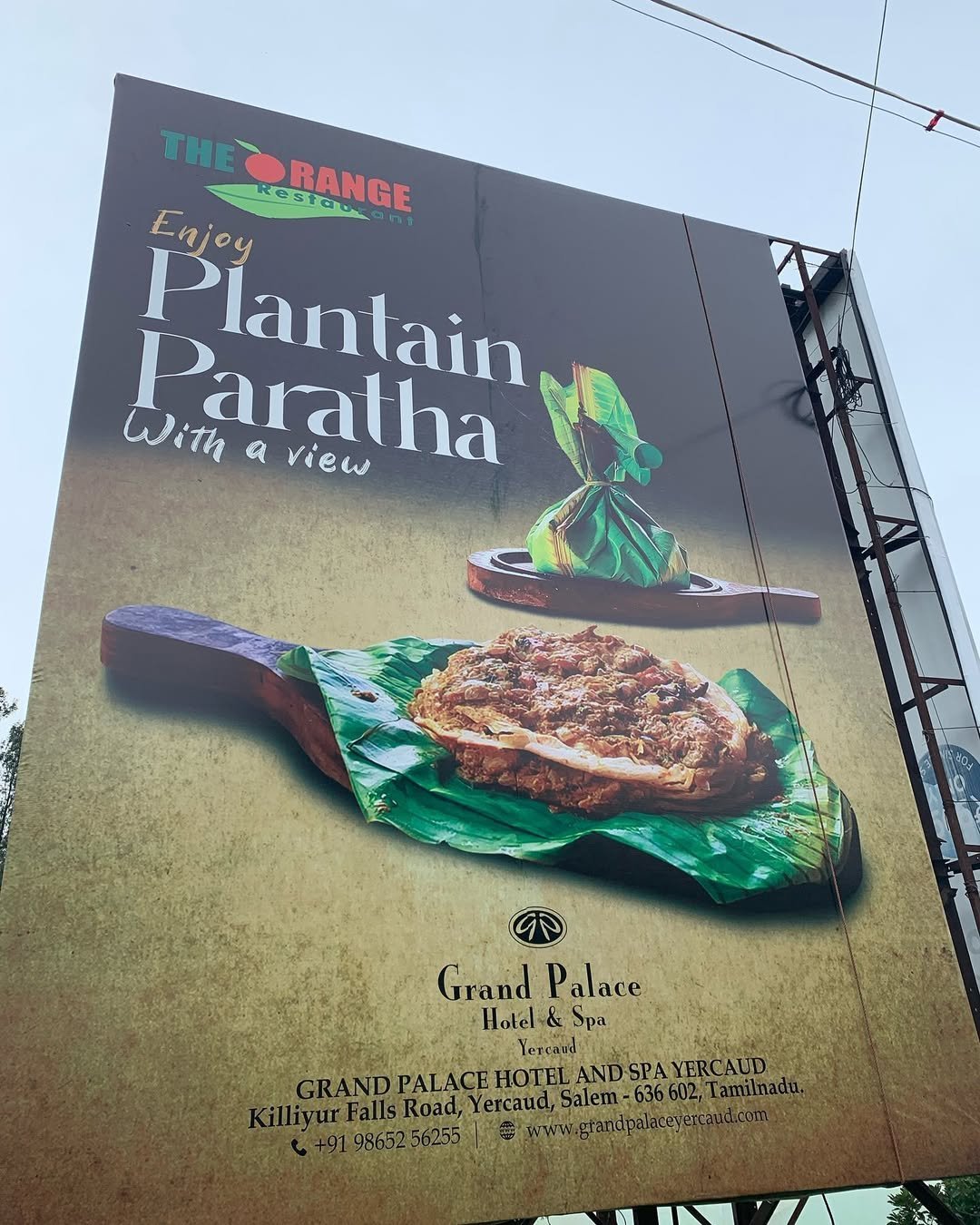
Whether the site is a flex hoarding, a unipole or a painted wall, visit it at the hour your customers pass before you approve the hoarding design. Note trees, wires, other hoardings, the legibility distance and whether the board is lit at night. Grand Palace’s hoarding in Yercaud (pictured) gives most of the board to its plantain paratha, with a short line above and the hotel’s name and contact details at the foot.
Tamil, English or both: choosing words for Salem audiences
Language is a media decision as much as a design one. Tamil reaches the widest range of people on Salem’s roads and town buses. English often suits brand names, premium products and the tourist route up to Yercaud, where many visitors may not read Tamil.
Two full messages in two languages usually means neither gets read. Let one language carry the message and keep the other to the brand name or one supporting line.
Setting Tamil for distance
- Tamil words often run longer than English ones, so test the real headline at the board’s real proportions.
- Shorten the words rather than squeezing or stretching the letters.
- Leave generous line spacing. Some Tamil vowel signs reach above or below the letters, and they are the first details to merge or be clipped by a frame edge or panel joint.
- Have a fluent reader check the printer’s proof, not only the design file.
Bus wraps: designing around windows, doors and wheel arches
Bus wrap design is not hoarding design on wheels. A bus side is broken by windows, doors, wheel arches, ribs, rivets, route boards and lights, and the artwork has to work around all of them.
How to lay out a bus wrap
- Work from photos and measurements of the actual bus model.
- Keep the windscreen, driver’s windows, route and number boards, lights and emergency exits clear.
- Place the brand name on the longest unbroken panel, not across a door or wheel arch.
- Treat the rear as the panel people stare at in traffic: name, one line and one way to reach you.
- The door side faces bus stops and pedestrians; the other side faces oncoming traffic.
Tamil Nadu’s 2023 urban local body rules (see below) also say vehicle advertising should not cover more than 75% of each side, or interfere with mandatory signs such as the route board and number plate.
Ask the media owner which buses and routes are on offer, whether they are TNSTC or private buses, which panels you are buying, which material will be used and how long the bus will be in the depot for pasting. Buses gather dust quickly, so high contrast matters even more than on a hoarding.

Van and vehicle branding: turning a vehicle into a moving shopfront
A branded van works twice: as moving media in traffic, and as a shopfront when it parks. For the Venu Dindigul Biriyani food van in Singapore, our team studied the brand’s existing identity before designing the wrap, then handled printing and execution.
On the finished van, the brand name runs along the top of the side panel, where it can be read from a distance. Food photography fills the space below, and the phone number, social handles and a QR code sit lower down for people standing near it.
Points to brief your designer on
- Use the vehicle’s base colour if a full wrap is not needed.
- Put the logo on the front doors and the name on the rear, as the Venu van does.
- QR codes work when the vehicle is parked, not when it is moving.
- Stay within the state’s vehicle-advertising limits, and ask the regional transport office whether your vehicle needs any other approval.
Theatre commercials: what fits in 10 and 15 seconds before the film
A cinema audience is seated, facing a large screen and hearing everything. It is a rare chance to show texture, colour and sound in a short slot. For My Dress Code, a premium saree brand, we made a one-minute brand film and a 15-second theatre commercial that ran in DNC and INOX theatres in Salem, with the media bought alongside.
Scripting a short cinema spot
- One idea only. In 15 seconds there is time for a product, a line and a name.
- Show the product in the first few seconds and say the brand name aloud.
- Hold the end card long enough to read the name and where to find you.
- Mix the sound for a cinema hall, not a phone speaker.
- Plan the 10, 15, 30 and 60-second versions at the script stage, so one shoot gives you every cut.
Ask your media partner which durations are sold at the screens you want, and which file format the cinema needs. Our film and video production page covers ad films, reels and theatre commercials.

From approved artwork to installation: what the timeline depends on
Outdoor work can move quickly when the decisions are made. Neelgiri’s bus wrap in Salem went from design to the road in a single day, and Grand Palace’s hoardings in Yercaud took three days from editing to installation. Read how both came together.
Your own timeline depends on:
- How quickly artwork and text are approved on your side
- The number of sites, buses or screens, and the size of each print
- Material and printer capacity, which can be stretched before festivals
- Whether permissions for the site are already in place
- Access: when the bus is free in the depot, or when installers can reach the board
- Rain and wind, which can stop installation
- For cinema, the booking cycle of the screens and certification of the spot
Ask for a written schedule with dates for artwork approval, proof, printing, installation and the first proof-of-display photos.
Permissions, ad standards and proof of display
Hoarding licences and banner permission
Under the Tamil Nadu Urban Local Bodies Rules, 2023 (PDF), a licence to erect a hoarding is applied for to the Commissioner of the local body, and a licensed hoarding must show the licensee’s name, licence number, licence period and size in its right-hand corner. Digital banners and placards need separate permission in advance, with a police no-objection certificate.
Inside city limits the local body is the Salem City Municipal Corporation. On an existing hoarding, look for those licence details and check that they cover your campaign dates.
Offers that hold up without the small print
The ASCI Code for Self-Regulation covers hoardings, posters and cinema as well as online ads. Claims must be truthful and capable of substantiation, and lines such as “prices from” or “up to” are not acceptable where they could mislead. Nobody reads an asterisk at road speed, so write the offer to be true without the conditions.
Cinema certification
According to the Ministry of Information and Broadcasting, films can be exhibited publicly in India only after certification by the Central Board of Film Certification, which has a regional office in Chennai. A cinema spot is shown to the public, so ask your media partner who applies and how long it usually takes.
Proof of display
Agree up front on dated photos of every hoarding and bus, and a screening confirmation for cinema spots.
Information, not legal advice
Rules are amended and applied locally. Confirm current requirements with the local body and your media partner before you print.
Buying the media and the creative together
When the same team plans the media and the artwork, the design is made for the actual site, bus or screen, and the print, installation and release dates line up. Both the Neelgiri bus campaign and the My Dress Code cinema spot included media buying alongside the creative.
Whether you work with an advertising creative agency in Salem or book media yourself, ask:
- Can I see the site or the route before I book?
- Are media, design, printing and installation quoted separately?
- Who holds the licence or the advertising rights for this space?
- What happens if a board is damaged or a bus goes off route?
For broader questions to put to any partner, see our guide on how to choose a creative design agency in Salem.
A pre-print checklist for outdoor and theatre artwork
Run through this list before any hoarding design, vehicle wrap or cinema file goes to the printer or the screen.
- Exact size, bleed and visible area confirmed by the media owner
- Colour mode, resolution and file format agreed with the printer
- Fonts embedded or converted, and Tamil text proofread by a native reader
- Phone number, address and offer terms checked twice
- Brand name readable at thumbnail size, in daylight and under lights
- Windows, doors, lights, route boards and number plates kept clear on vehicle layouts
- Site licence and campaign dates confirmed
- For cinema: exact duration, end card, sound mix, delivery format and certification
- Proof-of-display photos agreed
Frequently asked questions
Do I need permission to put up a hoarding in Salem?
Yes. In Tamil Nadu’s towns and cities, a hoarding needs a licence from the local body, which inside Salem city limits is the Salem City Municipal Corporation. If you book space on an existing hoarding, the media owner usually holds the licence, so ask to see it and check that it covers your dates. Digital banners need their own permission before they go up.
How long does it take to design, print and install a hoarding or bus wrap in Salem?
It depends on approvals, the number of sites or buses, print size, permissions, access and the weather. Short timelines are possible: Neelgiri’s bus wrap went from design to the road in a day, and Grand Palace’s hoardings in Yercaud took three days from editing to installation. Ask for a written schedule with dates for approval, proof, printing and installation.
How long should a theatre ad be: 10, 15 or 30 seconds?
For a single product or offer, 10 or 15 seconds is usually enough: one image, one line and the name. Longer spots suit a story or several products but need more screen time and budget. Ask your media partner which durations are sold at your chosen screens before you write the script.
Should outdoor ads in Salem be in Tamil, English or both?
It depends on who passes the site. Tamil reaches the widest audience on most city roads and buses, while English often suits brand names, premium products and tourist routes such as Yercaud. If you use both, let one language carry the message and keep the other to the name or a single line. Have a fluent reader check the printer’s proof.
Who benefits most from bus advertising in Salem?
Businesses that serve customers across the city, or along particular routes, tend to get the most from buses: retailers and showrooms, textile and saree stores, restaurants and sweet stalls, clinics, gyms and institutions. Because a bus is moving, it suits a simple name-and-offer message better than detailed information. Choose routes that pass through your own catchment and, ideally, your shop.
Do ads shown in cinemas need CBFC certification?
The Ministry of Information and Broadcasting says films can be shown publicly in India only after CBFC certification, and a cinema commercial is shown to a public audience. Treat certification as part of the schedule: ask your media partner who applies, what the cinema needs from you and how long it usually takes, before you fix a release date.
Planning a hoarding, bus wrap or cinema spot?
Tell us the site, route or screens you have in mind and the date it must go live, and we will help you plan the artwork, print and media. The Idea Shop, 3/77 Convent Road, Alagapuram, Salem 636 016, Tamil Nadu.
Keep reading

How to Choose a Creative Design Agency in Salem: 12 Questions to Ask Before You Hire
Twelve questions to ask a Salem design agency before you sign, from who owns your files and ad accounts to Tamil copy, print and festive deadlines.

Festival Social Media Posts for Tamil Nadu Businesses: Ideas from Pongal to Karthigai Deepam
Post ideas by business type for the major Tamil Nadu festivals, with 2027 dates from the official Government Order and practical lead times.
Logo Design Cost in Salem: What You Pay For, How the Process Works and the Files You Should Get
Why logo quotes in Salem vary so much, how a proper logo design process runs, and the files and checks to insist on before you pay.