
Packaging
Food Packaging Design in Salem: A Practical Guide for Sweet Shops, Bakeries and Food Brands
The decisions to make before you brief a designer or printer, from the pack's job and board to the label the law expects and your print timeline.
By The Idea Shop team, Salem19 November 202611 min read
On this page
- Food packaging design in Salem starts with the job: counter box, gift box, delivery box or shelf pack
- Choosing a structure: sweet boxes, bakery boxes, delivery boxes, pouches and labels
- Materials and finishes in plain language, and when each is worth paying for
- Designing festive editions for Deepavali and other Salem shopping peaks
- What a pre-packaged food label must carry under FSSAI's Labelling and Display Regulations
- Net quantity, MRP and consumer care: the Legal Metrology side of the label
- Tamil, English or Hindi: handling languages on a Tamil Nadu pack
- From concept to printed box: dielines, proofs, print runs and working back from your launch date
- What our packaging projects for sweet shops, bakeries and food brands taught us
- A one-page packaging brief to send your designer and printer
- Frequently asked questions
Key takeaways
- Good food packaging design in Salem starts with the pack's job: counter, gift, delivery or shelf.
- Match structure and board to the food; ghee sweets, cakes and biryani need different boxes.
- Pre-packed food must meet FSSAI and Legal Metrology label rules, and compliance sits with the brand owner.
- Mandatory label details go in English or Hindi; Tamil can sit alongside.
- Work back from the day boxes must be on your counter, and approve a printed proof first.
Walk into a busy sweet stall in the week before Deepavali and you may well see stacks of near-identical stock boxes, each with a sticker for the shop’s name. Once those boxes leave the counter, customers can barely tell one shop from another. Good food packaging design in Salem changes that, as long as the box also does its practical job and carries the label the law expects.
This guide is for sweet shops, bakeries, delivery kitchens and small packaged-food brands in and around Salem, and runs from the first decision about the pack to the printed box, with links to the official label rules. When you are ready for help, our packaging design in Salem service covers design and print production.
Food packaging design in Salem starts with the job: counter box, gift box, delivery box or shelf pack
Before colours or logos, decide what the pack has to do. Most Salem food businesses need one or more of four types:
- Counter box: filled in front of the customer at a sweet stall or bakery. It must fold quickly, stack well and look good in a carry bag, at a cost that suits everyday sales.
- Gift box: bought to be given, for Deepavali, weddings or corporate orders. The box is part of the present, so presentation and the moment of opening matter most.
- Delivery box: travels on a two-wheeler through Salem traffic. It must hold its shape, resist leaks and grease, and still arrive looking like your brand.
- Shelf pack: a sealed product such as snacks, spices, health products or packed sweets sold through shops. It has to sell itself on a crowded shelf and carry a full legal label.
Each type changes the structure, the budget and the label requirements, so name it at the top of your brief.
Choosing a structure: sweet boxes, bakery boxes, delivery boxes, pouches and labels
- Folding cartons and tuck-end boxes: printed flat and folded at the shop. The workhorse for counter sweets and bakery items.
- Tray and sleeve: a plain tray with a printed sleeve. An affordable way to make a stock box your own, and easy to change for a festival.
- Rigid boxes: thick board wrapped in printed paper, with a separate lid. They feel premium and suit gift boxes, but cost more to make, ship and store.
- Window boxes: a cut-out with clear film so the food sells itself. Popular for cakes, cookies and dry fruit.
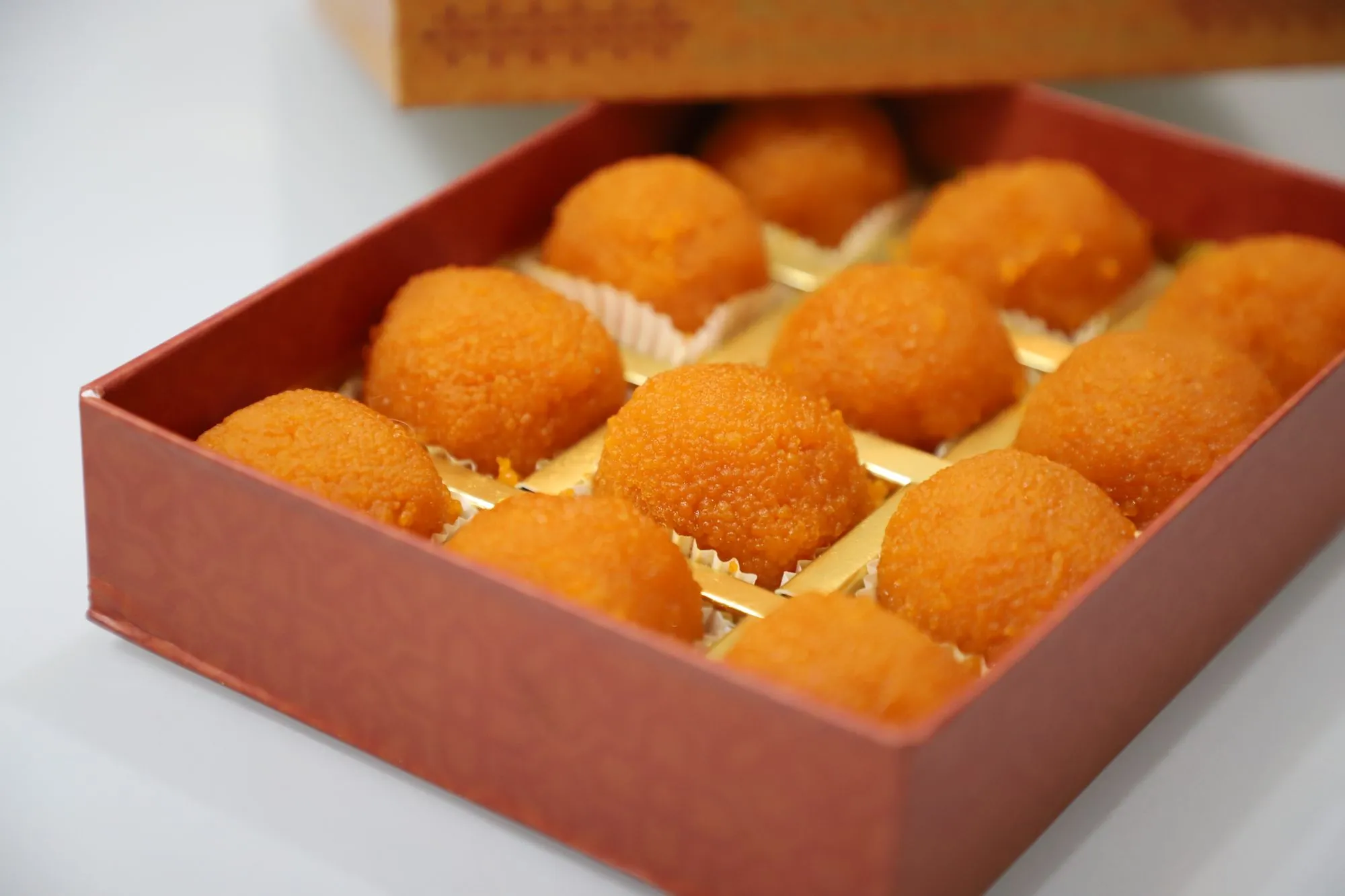
- Inner trays and cavity inserts: keep laddoos, burfi or cupcakes from rolling into each other.
- Corrugated boxes: fluted board that protects heavier and delivery orders.
- Pouches and labels: for snacks, spices and powders, a printed pouch or a well-designed label on a stock pouch is often the sensible start.
Delivery packs need particular care, because they have to survive the ride and still look like your brand when they are opened. For Venu Dindigul Biriyani in Singapore, The Idea Shop took a premium biryani delivery box from concept and design through to printing.

Materials and finishes in plain language, and when each is worth paying for
Board choice is where food packaging design in Salem meets your budget, so it pays to know the main options.
Board
- Duplex board: grey inside with a white printing face. Economical and common for everyday sweet and bakery boxes.
- White board: a brighter, cleaner print surface with a light reverse. Worth it when the inside of the box is seen, or for premium editions.
- Kraft board: natural brown. It suits a rustic or eco look but dulls bright colours.
- Greyboard wrapped in printed paper: the base of rigid gift boxes.
Finishes
Lamination, gloss or matt, protects the print and changes the feel; varnish is lighter. Spot UV, foil and embossing add highlights, but each needs extra set-up and time, so save them for the logo or the festive motif on a gift box.
Grease and food contact
Ghee-rich sweets such as Mysore pak, and oily snacks, can soak through plain board. Ask your printer about grease-resistant board, an inner coating or a greaseproof liner, and get written confirmation that the board and inks suit food contact.
Designing festive editions for Deepavali and other Salem shopping peaks
Deepavali is the big packaging moment for Salem’s sweet trade, with Pongal, weddings and corporate gifting adding their own peaks. A festive edition does not need a new brand. It needs a seasonal layer on a stable one:
- Keep the logo, colours and label panel fixed; change the pattern, sleeve, ribbon or insert.
- Design a family of sizes, such as quarter-kilo, half-kilo, one-kilo and assorted boxes, so the range looks planned.
- Leave space for a gift message or a corporate client’s logo on bulk orders.
- Match the box to your catalogue, posters and posts, so the season reads as one campaign.
Shri Gupta Sweets in Salem shows the rhythm. Its annual Diwali partnership with The Idea Shop covers festive photography, packaging and print every year. For a gift range, a catalogue can do as much selling as the box: for TVN Health we designed a Diwali gifting catalogue that presents its amla candy, powder, honey, juice and squash as festive gifts.
Timing matters most. Our guide to planning a Diwali campaign six weeks early sets out the order of work, and the festive planner shows the coming festival dates.

What a pre-packaged food label must carry under FSSAI's Labelling and Display Regulations
If your food is sealed in a pack before the customer sees it, it counts as pre-packaged food under the Food Safety and Standards (Labelling and Display) Regulations, 2020. The main items the label must carry are:
- The name of the food, on the front of the pack
- Ingredients in descending order by weight or volume (single-ingredient foods are exempt)
- Nutritional information, unless the food is exempt
- The green vegetarian or brown non-vegetarian symbol
- Food additive declarations, where additives are used
- The name and complete address of the brand owner
- The FSSAI logo and licence number
- A batch, lot or code number
- The date of manufacture or packing, and the expiry or use-by date
- Allergen declarations, such as milk, nuts, gluten or soy
- Instructions for use or storage, where needed
The regulations also set minimum letter heights based on the size of the principal display panel, and relax some items for very small packs. They have been amended several times since 2020, so check the current position on FSSAI’s labelling and display regulations page before you print.
The label is the brand owner's responsibility
A designer can lay out a clear label, but the facts on it and compliance with the rules sit with the food business. If unsure, check with a food safety consultant or your local food safety officer.
Net quantity, MRP and consumer care: the Legal Metrology side of the label
Three items on a retail food pack come from a different law. FSSAI’s regulations say the net quantity, the retail sale price (the familiar MRP) and consumer care details must be declared as the Legal Metrology Act, 2009 and its rules require, including the size of those figures.
In Tamil Nadu, the Labour Department enforces Legal Metrology, including the Legal Metrology (Packaged Commodities) Rules, 2011. Its inspection checklist asks whether packers are registered under those rules, whether pre-packed goods carry the mandatory declarations, and whether anything is sold above the printed price.
For design, that means three things: reserve a clean, uncluttered panel for these details, never run a festive pattern behind them, and confirm the wording and minimum sizes for your pack size before final artwork.
Tamil, English or Hindi: handling languages on a Tamil Nadu pack
FSSAI’s regulations ask for the mandatory label details in English or in Hindi (Devanagari script). Any other language, Tamil included, can be added, as long as it does not contradict the English or Hindi text.
For most Salem brands, a practical split looks like this:
- Front of pack: brand and product name in Tamil and English, sized so both read from across the counter.
- Mandatory panel: in English, complete and easy to find.
- Story, greetings and serving notes: in Tamil where it reads more warmly, such as a Deepavali wish on the lid.
If you repeat ingredients or storage advice in Tamil, have a native reader check that it matches the English exactly. Ask your printer not to retype or re-font Tamil text at the last minute, and send any correction back through your designer so the approved wording stays intact.
From concept to printed box: dielines, proofs, print runs and working back from your launch date
- Brief and structure: agree the pack type, sizes and quantity. Get the dieline, the flat cutting and folding template, from the printer or box maker before design starts.
- Concepts: review two or three directions on the real dieline, not just as flat pictures.
- Mock-up: print and fold a sample. Check how the food fits, how the lid and insert behave, and how the box looks in a carry bag.
- Label check: confirm every mandatory detail and its size.
- Print proof: approve colour on the actual board. Screen colours and print on duplex board can differ noticeably.
- Print run and delivery: plan where the finished boxes will be stored.
How long each step takes depends on quantity, board availability, finishes such as foil or embossing, and how busy printers are before Deepavali. Ask your designer and printer for a written timeline for your exact job, then work back from the day boxes must be on your counter, leaving room for one round of corrections.
What our packaging projects for sweet shops, bakeries and food brands taught us
- Show real alternatives. For Sri Meenachi Bakes, we developed three distinct packaging concepts, Classic Indulgence, Whimsical Delights and Gourmet Temptations, and took the work through design and printing. Three clear directions side by side make the choice easier than endless tweaks to one.
- Delivery packs are marketing. The Venu box was designed as a premium biryani delivery box, so the brand arrives with every order instead of a plain carton.
- Plan for the yearly return. Shri Gupta Sweets comes back each Diwali for festive photography, packaging and print, so each season can build on the last instead of starting from a blank page.
- Brand first, box second. Food packaging design in Salem works best on top of clear brand rules. If yours are not written down yet, our guide to what a branding agency does explains what they should cover.

A one-page packaging brief to send your designer and printer
A clear brief is the cheapest part of food packaging design in Salem. Send the same one to your designer and printer, so both work from one set of facts:
- Products, weights and shelf life
- Pack type: counter, gift, delivery or shelf
- Sizes and quantities for the first run
- How the pack is filled, sealed, stored and carried
- Budget per box, and whether it is a festive edition or a year-round pack
- Brand files: logo, colours, fonts and the Tamil form of your name
- Label content: final ingredients, FSSAI licence number, address, net quantity, MRP, consumer care details, veg or non-veg
- Languages, and any Tamil text already approved
- The date boxes must be on your counter
- Two or three packs you admire, and why
Before you approve final artwork
Fold a printed sample, fill it with the real product, read every label line aloud against your FSSAI licence and recipe, and check the box after a few hours with ghee sweets inside.
Frequently asked questions
What must be printed on a pre-packed sweet box?
For a sealed, pre-packed box, the FSSAI Labelling and Display Regulations call for the food’s name, ingredients, nutrition information unless exempt, the veg or non-veg symbol, additives, the brand owner’s name and address, the FSSAI logo and licence number, a batch number, date marking and allergens. Net quantity, MRP and consumer care details follow Legal Metrology rules. Check the current rules before printing.
Is a best before date enough, or does the box also need a manufacturing date?
For pre-packaged food, the 2020 regulations ask for the date of manufacture or packing and the expiry or use-by date, with best before allowed as extra information. For food with a shelf life of seven days or less, the manufacturing date may be left out, but the expiry or use-by date is still required. Many fresh sweets and bakery items may fall into that group, so settle your shelf life first.
Do the labelling rules apply to a box I fill at the counter?
The full label applies to pre-packaged food, meaning food placed in a package so that the contents cannot be changed without tampering, ready for sale. A box filled in front of the customer may not meet that definition, but duties remain: an FSSAI order of September 2020 requires sweet outlets to show a best before date on trays or containers of loose sweets. Confirm your situation with your food safety officer.
What does packaging design cost in Salem?
There is no standard price, because cost follows scope: the number of products and sizes, a stock box or a custom structure, how many concepts, any illustration or photography, label artwork, mock-ups and revision rounds. Printing is a separate cost driven by quantity, board and finishes. Ask for a quote that lists design and print separately, or start with the instant estimate on our Services page.
Do you offer eco-friendly packaging options?
We can design around lower-impact choices, and it helps to raise them in the brief. Common options are kraft or uncoated board, single-material boxes that are easier to recycle, fewer laminations and plastic windows, paper inserts instead of plastic ones, and right-sized boxes. What is practical depends on the food, its shelf life and the print run, so test a sample first.
Image credits: Photo by Sharath G. on Pexels, Pexels License. Other images: The Idea Shop client work.
Planning a new box or a festive edition?
Talk to The Idea Shop at 3/77 Convent Road, Alagapuram, Salem. Bring your product, your dates and a few boxes you like, and we will work through structure, design and print with you.
Keep reading
What Does a Branding Agency Do? Strategy, Identity and Guidelines for Salem Businesses
What a branding agency really does for a Salem business: strategy, identity, guidelines, rebrand or refresh, and how to write a brief.
Tamil Logo Design: Bilingual Logos and Name Boards for Salem Businesses
Your Salem customers read your name in Tamil first. How to build a Tamil and English logo that works on boards, packs and phones, within the rules.

Festival Social Media Posts for Tamil Nadu Businesses: Ideas from Pongal to Karthigai Deepam
Post ideas by business type for the major Tamil Nadu festivals, with 2027 dates from the official Government Order and practical lead times.